
Machine learning potentials
Why settle on a functional form?
The potential energy has many complex features:
Number of minima exponential on N
Multiple transition paths
Features at different length and energy scales
Approaches to approximate the true potential energy function:
Quantum-mechanical calculations would be very accurate, but are way too expensive
The classical forcefields from the previous lectures are cheap but only a crude approximation
Machine learning can approximate a region of the function close to QM accuracy but with much less expensive function evaluations
Machine learning
Regression: Predict the continuous outcome/function value given some new unseen input
Step 1: Collect data (measurements, calculations)
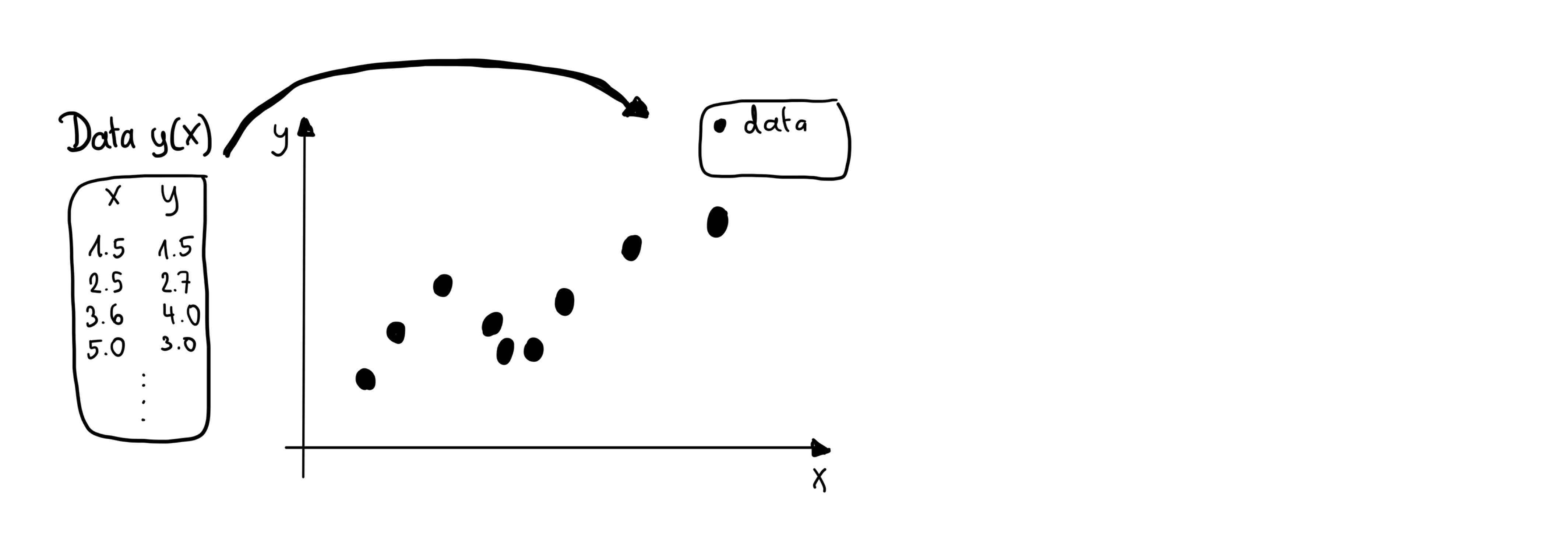
Step 2: Fit model (find best parameters of function)
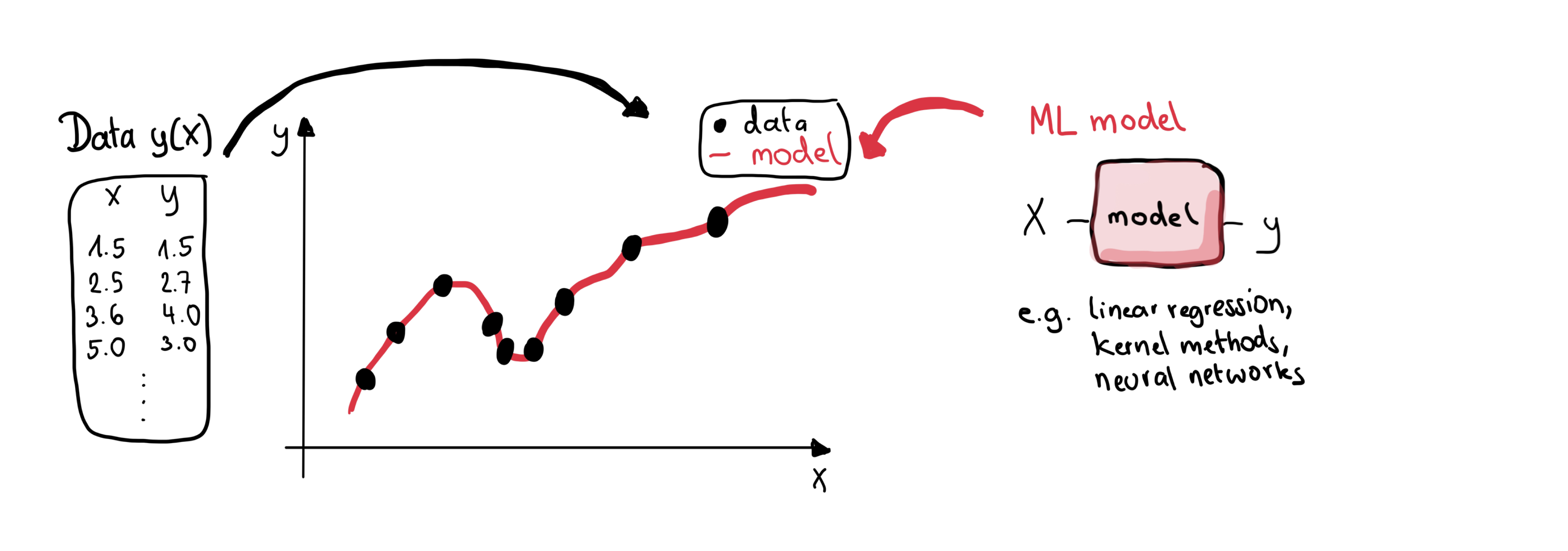
Step 3: Apply model, e.g. y(2.0)=2.1
Machine-learning (ML) potentials
Data: ... potential energy as a function of the atomic coordinates from QM calculations for many relevant conformations (+ optionally atomic forces )\[0.07cm]
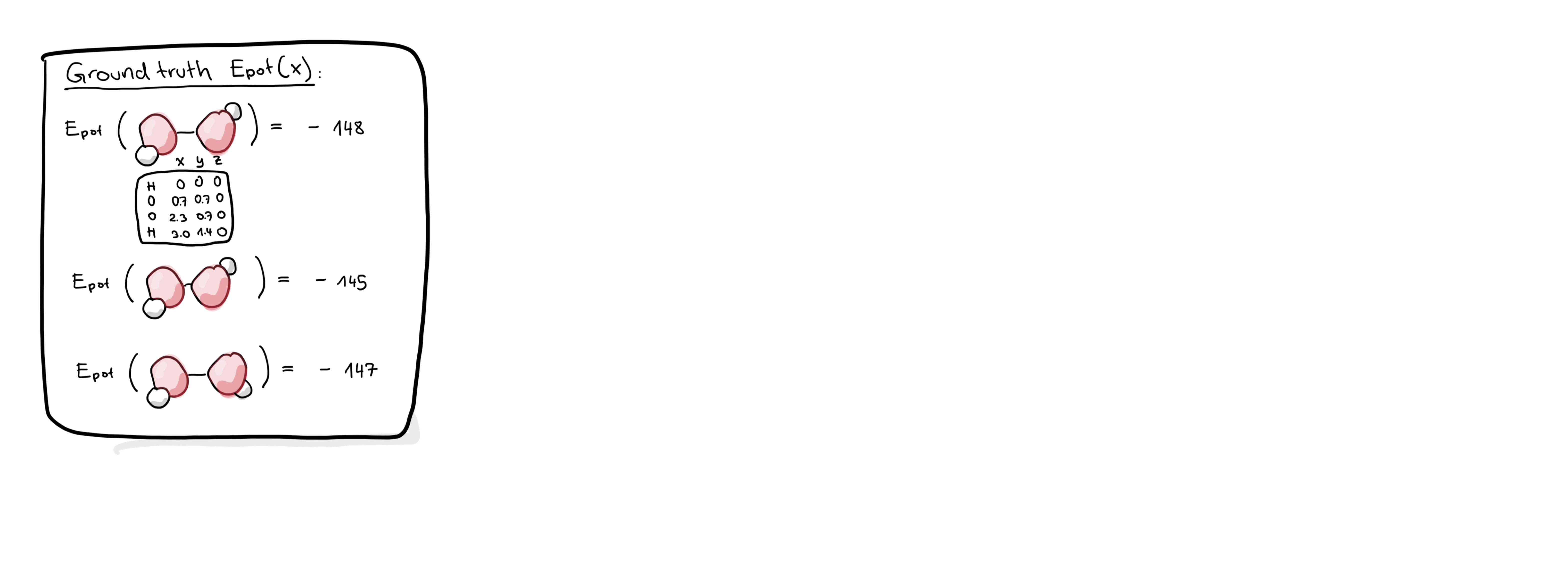
Problem: Learned potential energy would not be permuation, translation, or rotation invariant!
Assumption 1: is approximately additive with respect to the atomic contributions
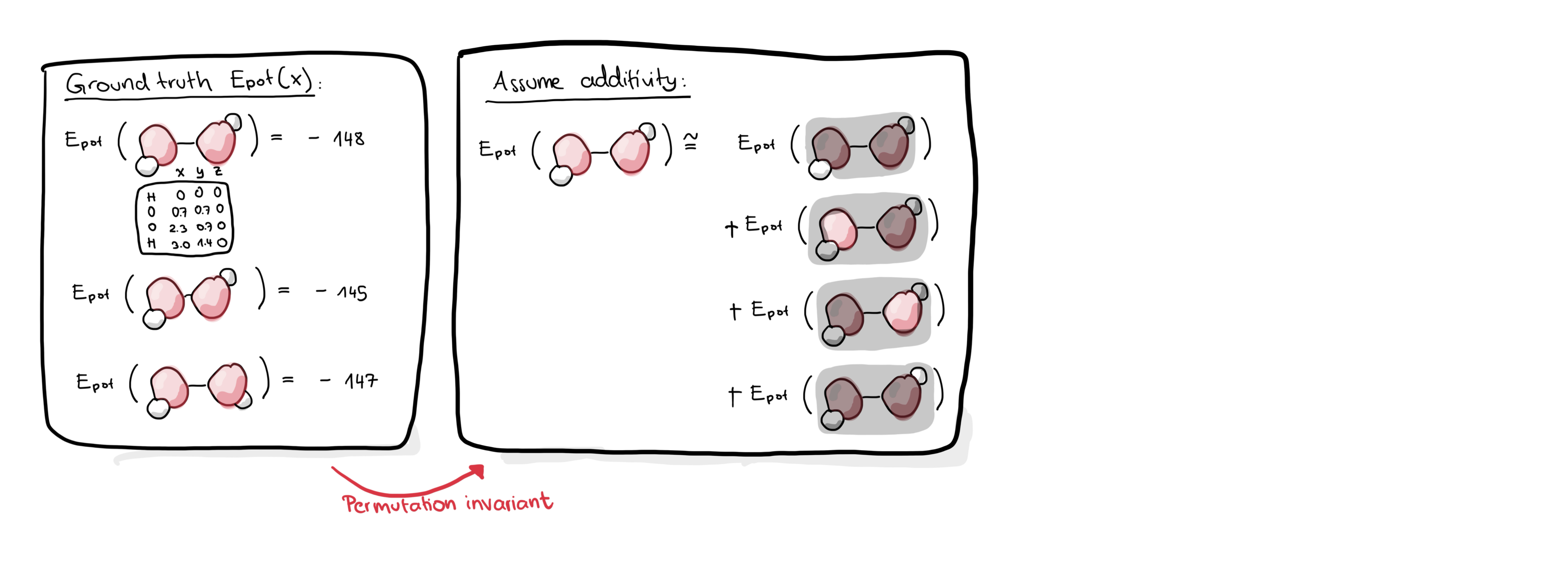
Problem: Learned potential energy would not be translation or rotation invariant!
Assumption 2: The atomic contribution can also be learned from with being a descriptor representation of the local environment around atom N
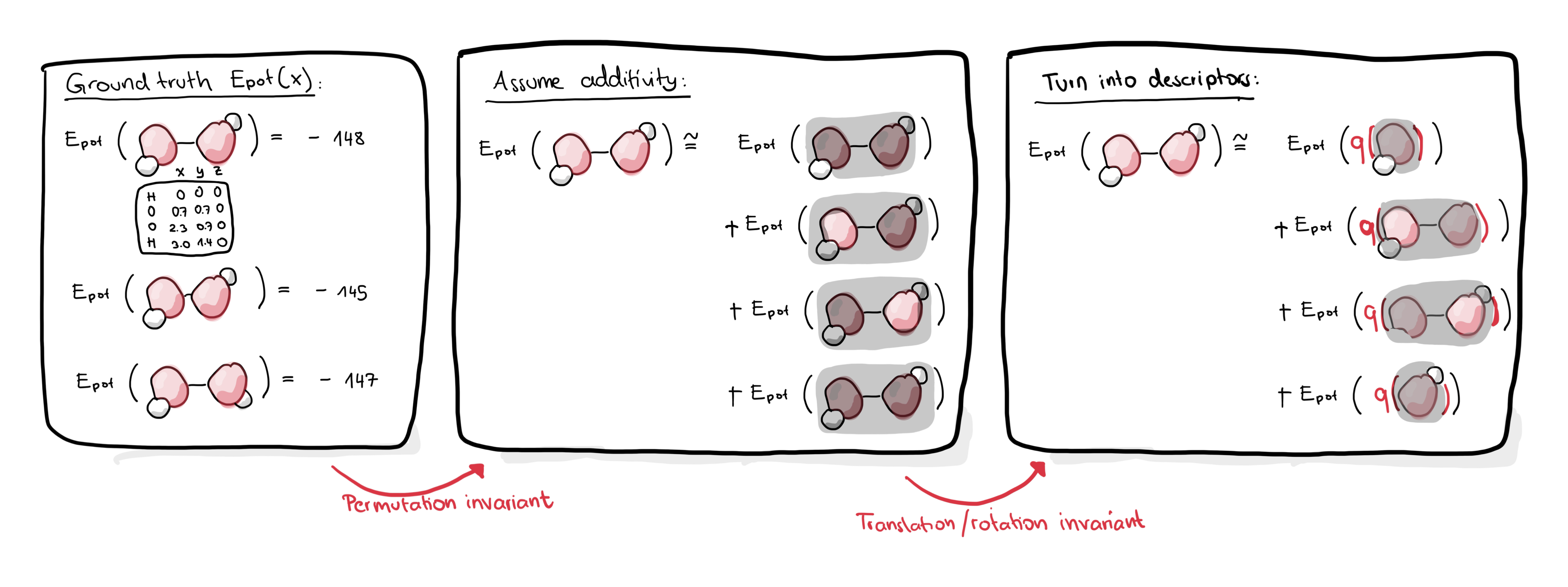
Problem: We must choose/design suitable descriptors
How to design a descriptor
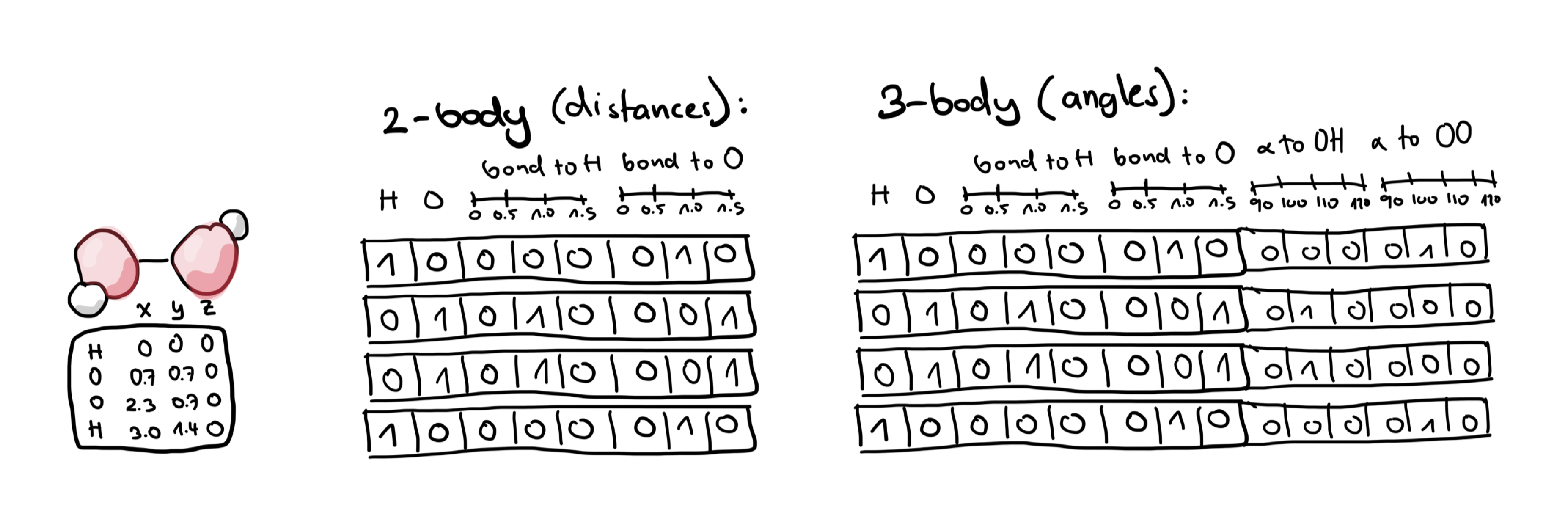
Descriptors must be invariant with respect to translation, and invariant or equivariant with respect to rotation.
Simplest choice: Two-body (atom + distance information), or three-body (atom + distance + angle information)
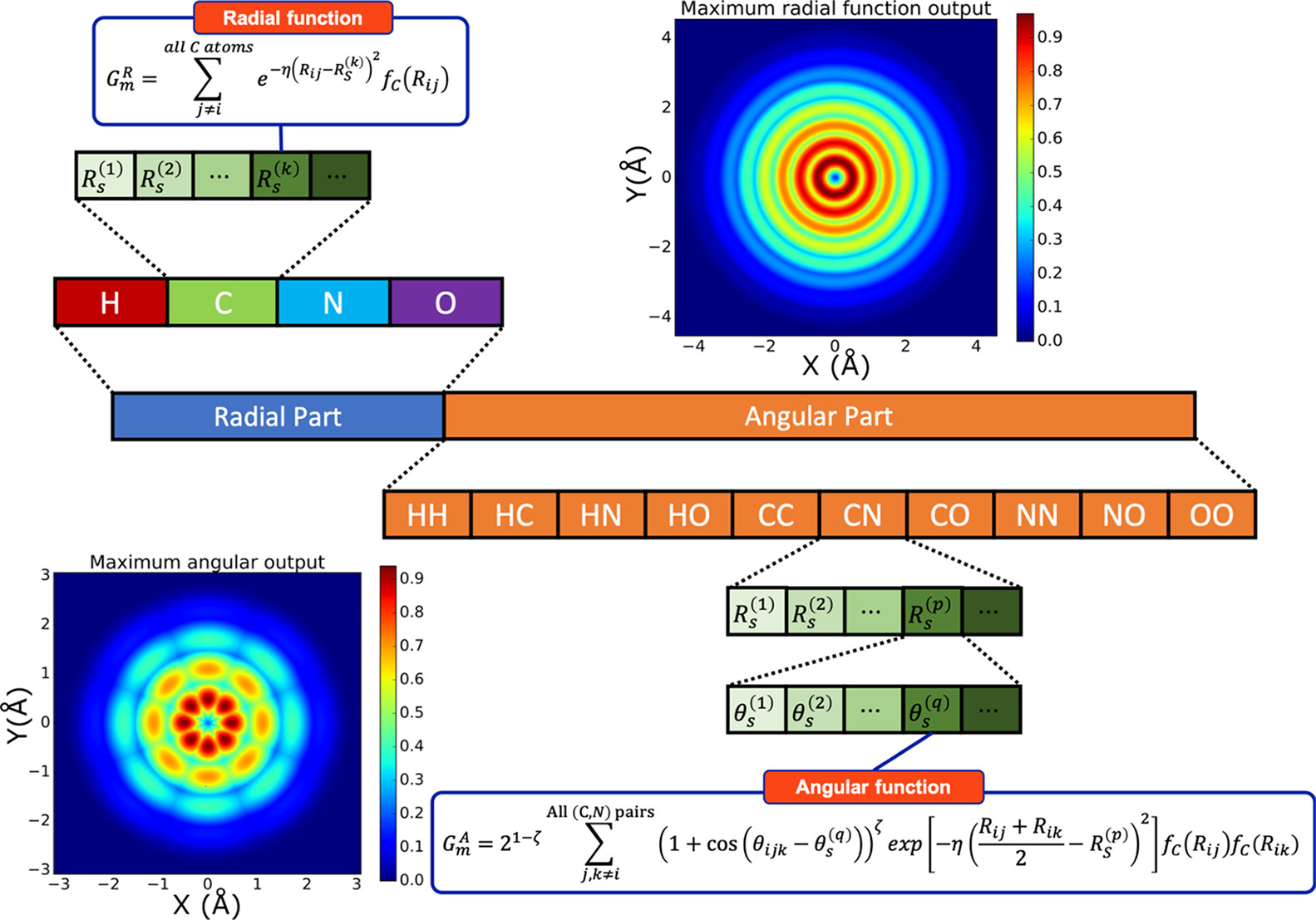
Usually: Many-body representation (all neighboring atoms up to a cutoff) with a radial part and an angular part (usually based on spherical harmonics):
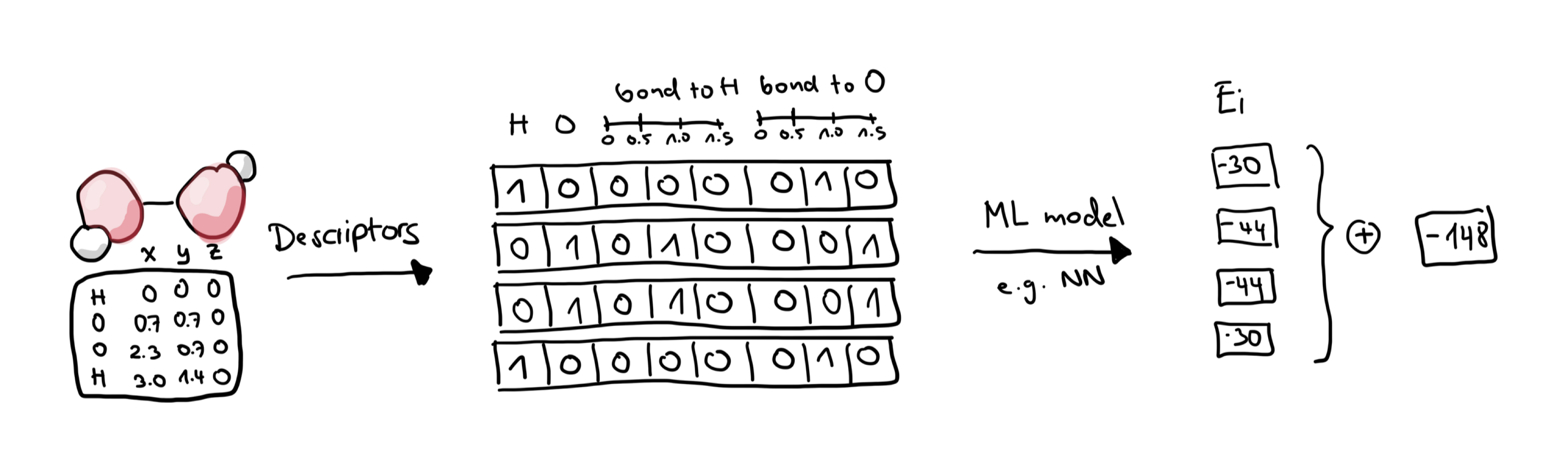
Descriptor-based architectures
Design of descriptors is still a work in progress, many variants published recently:
Atom-centered symmetry functions (ACSFs)
Smooth overlap of atomic positions (SOAP)
Eigenvalues of the Coulomb matrix
Exemplar architectures:
GAP: Gaussian process regression on SOAP descriptors
NeuralIL: Residual neural network on Bessel descriptors
ANI: Neural network on ACSFs
Learned descriptors
So far, we have custom-made the descriptors, relying on expert knowledge which information is important:
Instead, we can learn the descriptor from the data using message passing (= another model):
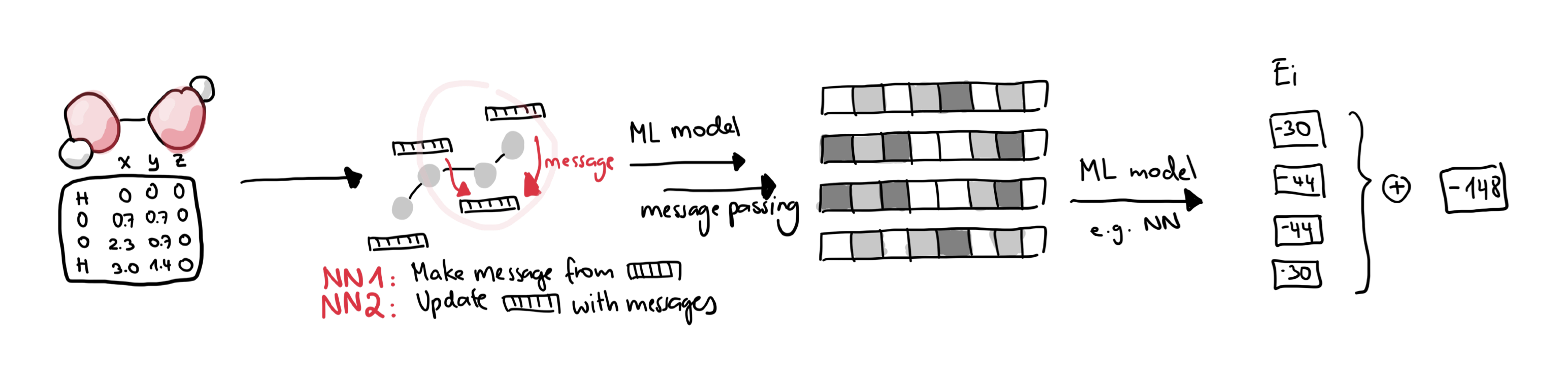
Evolution of learned descriptors:
2-Body (atoms I, J) invariant message passing with scalar features: Very basic learned features
Multi-body messages including also triples (atoms I, J, K) or more: Can capture more information
2-Body (atoms I, J) equivariant message passing with scalar and vectorial features: Can also capture directional information
Combination of equivariant message-passing with multi-body messages: Currently one of the best models
What about the long-range part?
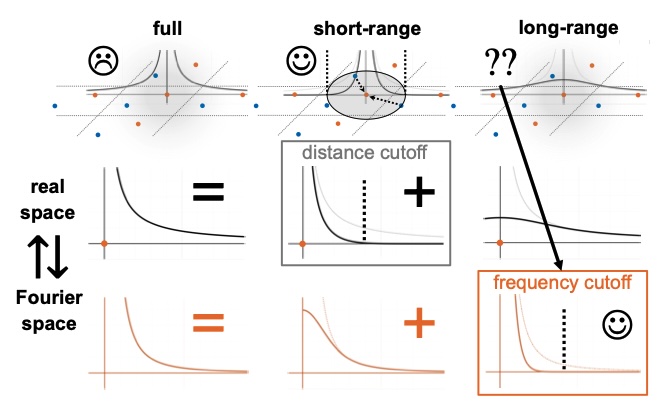
Previous methods only use local descriptors. What about long-range forces though?
Thre is commonly accepted approach yet. Some possibilities:
Fixed atomic multipoles (charges, dipoles, etc)
Machine-learning method for the charge density and the derived potential energy
Project long-range part onto local descriptors
Ewald-type ML
 proceedings
Disadvantages/Challenges
The development of machine-learned force fields is far from finished, and many challenges remain. Maybe you want to contribute?
No functional form means no safety net - predictions can get arbitrarily different from the ground truth. Predictions can thus even have a wrong sign, i.e. be attractive instead of repulsive
Generalization ability often poor
High dependence on training set
Currently promising results after some finetuning, but not off-the-bench
- Zubatiuk, T., & Isayev, O. (2021). Development of Multimodal Machine Learning Potentials: Toward a Physics-Aware Artificial Intelligence. Accounts of Chemical Research, 54(7), 1575–1585. 10.1021/acs.accounts.0c00868